Designing next-generation electric vehicles (EVs) comes down to a relentless game of margins. Engineers constantly balance weight, thermal efficiency, cost, and packaging space. When it comes to power distribution, the debate always lands on the same question: should you use copper or aluminum for your EV busbars?
While aluminum wins on the scale and at the checkout counter, copper remains the gold standard for high-power-density applications where space constraints and thermal efficiency are non-negotiable. Here are the physical and economic trade-offs engineers must navigate.
Key Takeaways
- Copper carries about 64% more current than aluminum for the same cross-section (100% vs. 61% IACS).
- An aluminum busbar needs roughly 60% more cross-sectional area to match copper, yet still ends up about 50% lighter.
- Copper wins where space, heat dissipation and long-term joint reliability matter; aluminum wins where weight and raw material cost dominate.
Conductivity vs. Weight: The Physical Face-Off
The primary job of a busbar is to move high electrical currents with minimal losses.
- Electrical conductivity: Pure copper has an electrical conductivity of 100% IACS (International Annealed Copper Standard). Aluminum (typically grade 6101 or 1350) sits around 61% IACS.
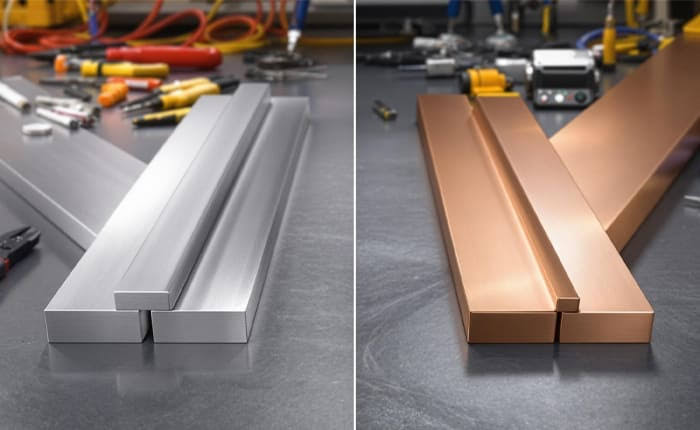
- The cross-section penalty: Because aluminum is less conductive, an aluminum busbar must have roughly 60% more cross-sectional area than a copper busbar to carry the same current.
- The weight paradox: Despite being physically larger, aluminum is very light, weighing about one-third as much as copper. Even after thickening the aluminum bar to match copper’s performance, the aluminum assembly is still roughly 50% lighter than its copper equivalent.
Thermal Management and Fatigue
In an EV battery pack or inverter, heat is the enemy. Copper’s thermal conductivity is about 390 W/m·K, whereas aluminum alloys sit around 220 W/m·K, so copper moves heat out of tight enclosures far more efficiently.
EVs also experience severe vibration and thermal cycling. Copper has a lower coefficient of thermal expansion than aluminum (about 17 vs. 23 µm/m·K), meaning it expands and contracts less under heavy electrical loads. This reduces mechanical stress on bolted joints and welds over the vehicle’s service life.
Joints, Oxidation and Corrosion
Aluminum forms a hard, electrically insulating oxide layer within moments of exposure to air. Bolted aluminum joints therefore need careful surface preparation, contact compound or plating, and periodic re-torquing to keep contact resistance low. Copper’s surface oxide is far less problematic, and tin-plated copper busbars add corrosion resistance and stable contact resistance at connection points.
Where copper and aluminum conductors must meet, tin plating or bimetallic transition pieces are used to prevent galvanic corrosion between the two metals.
Copper vs. Aluminum Busbar Specs Compared
| Property | Pure Copper (C11000) | Aluminum (6101-T6) |
|---|---|---|
| Electrical Conductivity (% IACS) | 100% | 61% |
| Thermal Conductivity (W/m·K) | 391 | 218 |
| Coefficient of Thermal Expansion (µm/m·K) | 17 | 23 |
| Tensile Strength (MPa) | 220–380 | 200 |
| Density (g/cm³) | 8.89 | 2.70 |
Cost: Material Price vs. System Cost
Per kilogram, aluminum is substantially cheaper than copper, and because it is lighter, a given current rating needs fewer kilograms of it. But total system cost also includes the larger enclosure, extra insulation and joint hardware an aluminum busbar may require, plus maintenance on bolted joints. In compact battery packs and inverters, these packaging costs often narrow the gap.
The Verdict: Packaging Space Wins
If your EV architecture has a large footprint and weight reduction is the only metric that matters, aluminum is a compelling choice. However, for compact high-voltage battery modules, fast-charging systems and high-performance inverters, copper’s superior volumetric efficiency makes it irreplaceable. It lets you pack more power into a tighter, cooler and structurally safer space.
TASA Gulf Industry manufactures bare copper bus bars and tin-plated copper bus bars from 99.99% oxygen-free copper in Dubai. Request a quote with your cross-section, length and plating requirements, or read our buyer’s guide to specifying custom copper components.
Frequently Asked Questions
Is copper or aluminum better for EV busbars?
Copper is better where space is tight and heat must be removed quickly, such as battery modules, inverters and fast-charging hardware. Aluminum is better where the busbar can be physically larger and minimizing weight and material cost is the priority.
How much bigger does an aluminum busbar need to be than copper?
Roughly 60% more cross-sectional area for the same current, because aluminum’s conductivity is about 61% of copper’s. Even at that larger size, the aluminum busbar weighs about half as much.
Why are copper busbars tin plated?
Tin plating protects copper from oxidation and corrosion, keeps contact resistance stable at bolted joints, and makes copper compatible with aluminum connections by reducing galvanic corrosion.